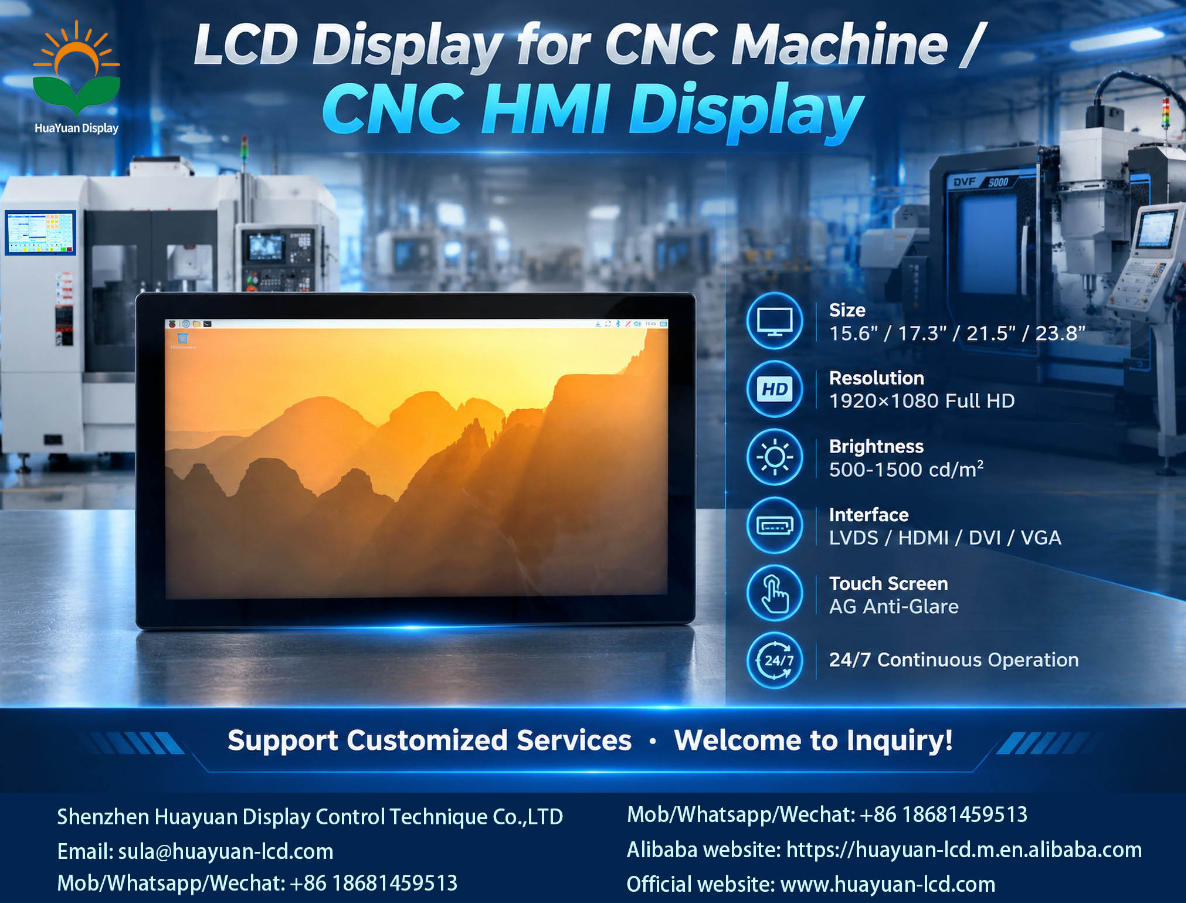
LCD Display solutions Applications in CNC Machines
1. Core Application Scenarios
1. Main Control Operation Panel of Machine Tools (Largest Consumption)
Built-in TFT-LCD for CNC systems such as FANUC, Siemens, Mitsubishi, HEIDENHAIN, Huazhong CNC and KND.
Functions: G-code editing, 3D toolpath simulation, real-time display of coordinates/feed rate/spindle speed, tool offset, alarm messages, parameter configuration and program recall.
Popular sizes: 8.4″ /10.4″ /12.1″ /15″ /19″. High-end 5-axis and gantry machines adopt large screens up to 21.5″, many supporting multi-touch.
2. Handheld Handwheel Terminals (Small-size LCD)
Portable handheld operation boxes equipped with small LCDs (4.3–7 inches). Used for on-machine workpiece alignment, axis fine adjustment and coordinate checking. Vibration resistance and glove operability are required; resistive touch is mostly adopted.
3. Independent Console / Remote Monitoring Screens
Separate monitors beside machines or in workshop control rooms. Multiple screens display the status of several CNC machines simultaneously, production statistics and OEE data. Common sizes: 15.6/19/21.5-inch large-format LCDs.
4. Replacement for Aged Machine Retrofit (Stock Market)
A large number of old units have failed CRT displays. They can be directly replaced by industrial LCD modules with compatible timing (with CGA/RGBHV/RGBS compatible driver boards). This is an important order source for independent LCD module suppliers.
2. Mandatory LCD Requirements for CNC Machines (Key Points for Foreign Trade)
• Brightness: 600–1000 cd/㎡ for general workshops; 1000–1500 cd/㎡ for workstations near windows or under strong ambient light; 400–600 cd/㎡ for regular indoor workshops. Consumer-grade panels at 250–300 nits are insufficient, as G-code and toolpaths become unreadable due to reflection.
• Wide Temperature Range: Standard industrial grade: -20℃ ~ +70℃. Versions with heating films (-30~+85℃) are selected for unheated workshops in cold regions or hot machine enclosures, considering heat from servo drives and drastic temperature fluctuations.
• Vibration Resistance: Continuous cutting vibration exists during machining. Reinforcement is required for panels, backlights and driver boards to avoid flickering, distorted images or black screens.
• Protection Rating: IP65-rated front panels to resist cutting fluid, oil mist and metal dust; metal housings for corrosion resistance.
• Touch Options:
◦ Resistive touch: Traditional preference for CNC. Supports operation with gloves and styluses, oil-stain resistant, ideal for workshop environments.
◦ PCAP capacitive multi-touch: Adopted on new high-end systems (DMG, latest FANUC). Enables gesture zoom for 3D toolpaths, suitable for clean environments.
• EMC Electromagnetic Compatibility: Servo drives and inverters generate heavy interference. LCD driver boards must feature anti-interference design and comply with EN61000. Available interfaces: LVDS/RGB/eDP; legacy machines additionally require compatibility with special timing such as CGA/RGBHV.
• Long-lifespan Backlight: 24-hour continuous operation. Backlight lifespan ≥ 50,000 hours. Industrial Grade A panels with low defective pixel rates and long product availability (stable supply for 5–10 years). Machine manufacturers highly value stable supply, as consumer panels are phased out quickly.