Exactly how many touch points can multi-touch support?
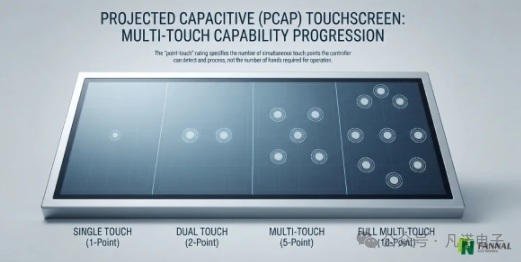
When selecting touch displays, we often encounter specifications such as "5-point touch" or "10-point touch." Upon seeing "10-point touch," many people’s immediate reaction is that the screen can simultaneously recognize 10 fingers. However, from the perspective of actual touch screen design, the reality is more complex. For the commonly used projected capacitive (PCAP) touch screens, the number of touch points is not determined by a single component; rather, it depends on a combination of factors, including the touch sensor, touch IC, firmware algorithms, cover glass structure, and the device's operating environment. Therefore, "10-point touch" is more accurately understood as the touch system's capability to detect and track up to 10 touch points simultaneously under specified conditions, rather than a guarantee of stable recognition of 10 points in every possible environment.
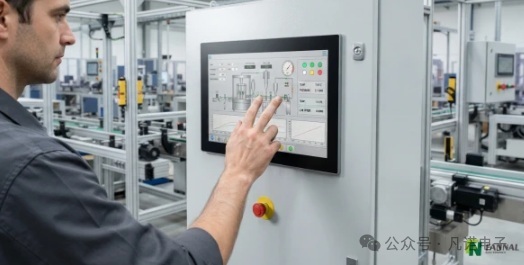
I. What exactly does "10-point touch" mean? "10-point touch" generally refers to the ability of a PCAP touch screen to detect and track up to 10 touch locations simultaneously. Applications such as two-finger zooming, two-finger scrolling, multi-finger gestures, and simultaneous operations in multiple zones all fall under the category of multi-touch. However, the number "10" is not an absolute figure independent of the usage environment. Factors such as the distance between touch points, the method of finger interaction, cover glass thickness, the use of gloves, the presence of water on the screen surface, and electromagnetic interference from the device itself can all affect recognition performance. Consequently, in actual projects, rather than focusing solely on the "maximum number of supported points," it is more practical to determine how many touch points the product truly requires and under what conditions those points must remain stable.
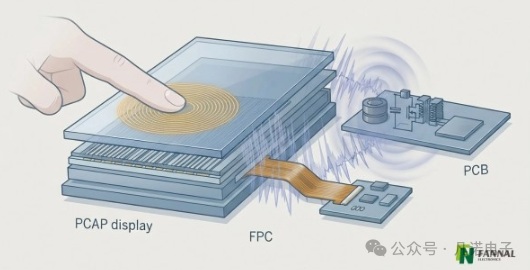
II. How is PCAP multi-touch implemented? The basic principle of PCAP touch screens involves determining finger position by detecting changes in capacitance during the touch process. The touch sensor contains electrodes arranged in a specific pattern; when a finger approaches or touches the screen, it alters the local electric field and capacitance state. The touch IC scans and processes these changes, while firmware and algorithms determine where actual touches have occurred. The entire process can be summarized as follows: Finger → PCAP Sensor → Touch IC → Firmware/Algorithm → Host System. The sensor is responsible for capturing electrical signals generated by touch, while the touch IC scans and processes these signals. Firmware and algorithms handle the identification of touch points, the tracking of their movement, and the filtering of interference; ultimately, the host system receives the touch coordinates and executes the corresponding actions. Therefore, multi-touch is effectively a comprehensive system capability rather than a function determined solely by a specific touch IC.
III. What factors influence the number of touch points? First is the touch sensor itself. Factors such as the number of electrodes, their arrangement, sensing channels, and overall dimensions all impact multi-touch capabilities. If two touch points are very close together, the system requires sufficient sensing data to accurately distinguish between them. Second is the touch IC, which scans the sensor and processes signals—tasks that typically involve multi-touch processing, signal filtering, touch point tracking, and noise management. However, it is important to note that even if a touch IC supports 10-point touch, this does not guarantee that any connected sensor will reliably achieve 10-point touch; the sensor structure and system configuration must also be compatible. Additionally, firmware and algorithms influence the final performance, as the system must differentiate between genuine touch signals and noise or interference, while also identifying and tracking multiple touch points. Screen size also plays a role, though it cannot be simply assumed that "a larger screen supports more touch points." While large touchscreens offer a greater touch area, actual touch capability still depends on sensor structure, electrode layout, and the control scheme. Some large-scale industrial equipment requires only single-point or dual-point operation, making 10-point touch capability of little practical value; conversely, some small-format devices may require high multi-touch capabilities to support complex multi-finger gestures. Therefore, the number of touch points should be determined by actual interaction requirements rather than solely by screen size.
IV. How do cover glass, gloves, and water affect touch performance? PCAP (Projected Capacitive) touch technology fundamentally relies on detecting minute changes in capacitance; consequently, the distance between the finger and the sensor affects the touch signal. When the cover glass is thick or additional structural layers are placed over the touchscreen, the distance between the finger and the sensor increases, placing higher demands on the touch signal. However, this does not mean that thick cover glass cannot support multi-touch functionality; the key lies in whether the sensor, touch IC, and the entire touch stack-up have been designed to work together effectively. Wearing gloves can also affect touch performance. While there is typically strong capacitive coupling between a bare hand and a PCAP sensor, certain gloves can attenuate this signal—the extent of the impact depends on the glove's material, thickness, and fit. Therefore, if a device is intended for use in industrial, medical, or outdoor settings where gloves are worn, testing should be conducted using the specific gloves used in actual operation, rather than relying solely on bare-hand testing. Water is another critical factor for PCAP touch technology. Water droplets or films alter the electrical state of the touch surface, potentially causing issues such as false touches, missed touches, or unstable touch points (jitter). It is important to distinguish between "water resistance" and "wet-touch capability": a waterproof touch screen structure does not guarantee that multi-touch functionality will operate correctly when water is present on the screen surface. If a product is to be used in humid environments, wet-touch performance should be verified separately based on actual application conditions.
V. Why does EMI affect multi-touch performance? PCAP touch technology relies on detecting minute changes in capacitance, making it susceptible to the surrounding electromagnetic environment. In industrial equipment, components such as DC/DC converters, motors, relays, switching power supplies, and high-speed digital circuits can generate electrical noise. A touch screen might perform normally during isolated testing, but once installed in the complete device, strong interference from the motherboard, power supply, or other electronic components can lead to false touches, missed touches, or unstable touch points. Consequently, multi-touch testing cannot be limited to the bare screen; the environment of the fully assembled device must also be considered. For industrial equipment in particular, testing should encompass the motherboard, power supply, FPC, connectors, and major electrical loads. Since multi-touch systems must simultaneously identify multiple touch signals, changes in the noise environment can compromise the system's ability to identify and track touch points reliably.
VI. Why might actual performance differ between two systems that both support 10-point touch? Even if two PCAP touchscreens are both rated for "10-point touch," their performance in actual products may still differ. This is because performance is influenced by factors beyond just the touch IC, including sensor structure, electrode layout, firmware algorithms, cover glass, the touchscreen stack-up, the FPC and connection method, as well as the power supply and EMI environment of the final product. Therefore, simply comparing "5-point" versus "10-point" capabilities does not provide a complete picture of a touchscreen's performance. For instance, if an industrial device requires operation by only two fingers, a stable and accurate 2-point touch solution might be more suitable than a screen that theoretically supports 10 points but is prone to false touches in the actual operating environment. For engineering projects, the key factors to consider are the number of touch points, touch accuracy, response speed, and stability under real-world conditions.
VII. How should multi-touch be tested? Testing multi-touch involves more than just placing ten fingers on the screen simultaneously to see if they are recognized. A more robust approach is to incrementally increase the number of touch points—testing 1, 2, 5, and up to 10 points—while observing whether the contact points are consistently recognized and tracked. Additionally, testing should cover various locations, including the screen center, edges, corners, and points positioned close together. If the product has specific usage requirements, further testing should be conducted for bare-hand operation, the specific gloves used, wet hands, water droplets or films, and varying touch speeds. For embedded and industrial devices, testing must be performed within the final system configuration, incorporating the actual motherboard, power supply, DC/DC converters, FPC, connectors, and potential sources of interference such as motors and relays. Only by including these conditions in the testing process can one accurately predict how the product will perform once deployed.
VIII. When selecting a multi-touch screen, look beyond the "10-point" specification. If you are undertaking a new touch display project, rather than simply stating a requirement for "10-point touch," it is far more effective to clearly describe the actual usage conditions. Factors to consider include the number of simultaneous touch points required, display size, cover glass thickness, glove compatibility, wet-touch performance, touch accuracy requirements, operating temperature range, and the presence of strong electromagnetic interference (EMI) in the device's environment. Such details are far more valuable than simply specifying "10-point touch." Ultimately, a touchscreen is part of an integrated system where the sensor, touch IC, firmware, cover glass, and the device environment must all work in harmony.
In summary, "10-point touch" is merely one parameter of a PCAP touchscreen and cannot, on its own, represent the screen's actual performance. A stable multi-touch system relies on the seamless coordination of the sensor, touch IC, firmware algorithms, cover glass structure, and the device environment. Furthermore, factors such as cover glass thickness, glove usage, the presence of water, EMI, and the installation environment can all affect the detection and tracking of multiple touch points. Therefore, when selecting a touchscreen, rather than fixating on the number of supported touch points, it is more practical to clarify the actual requirements: how many touch points does the product truly need, and under what environmental conditions must they operate reliably? These are the critical considerations when designing and selecting a multi-touch system.