The Application of LCD Screens in Metal Detectors
The Application of LCD Screens in Metal Detectors
In numerous fields—including industrial quality inspection, public security, precision manufacturing, and resource exploration—metal detectors serve as critical equipment for ensuring production safety, product quality, and site security. As the intelligent and digital transformation of various industries continues to advance, the market is imposing increasingly rigorous standards on metal detectors regarding detection accuracy, operational convenience, data visualization capabilities, and device stability. Leveraging advantages such as low power consumption, high visibility, broad adaptability, cost-effectiveness, and integrated data interaction capabilities, LCD screens have comprehensively replaced traditional display structures—such as digital tubes and indicator lights—to become an indispensable core component of modern metal detectors. This shift has effectively driven the iterative upgrade of metal detection equipment, transitioning it from simple mechanical alarm systems to intelligent, visualized, and data-driven devices.
I. Display Deficiencies in Traditional Metal Detectors
Early mass-produced metal detectors featured simple structures and extremely limited display and interaction methods. They relied solely on flashing indicator lights and audible buzzers to signal metal detection alarms, merely informing staff that "a metallic foreign object has been detected" without providing any actionable detection data. In practical operational scenarios, adjustments to device sensitivity and mode switching were performed entirely via physical buttons—a "blind adjustment" process heavily dependent on the operator's experience. This approach frequently led to parameter setting deviations, resulting in issues such as false positives and missed detections.
Furthermore, traditional devices lacked the ability to record detection counts, fault information, or environmental interference data, thereby possessing no data traceability capabilities. In the event of a quality control incident or a security breach, it was impossible to trace the device's operational status or review past detection records. Consequently, these devices struggled to meet the standardized management and control requirements of industries such as food and pharmaceutical safety production, factory security, and precision component inspection. The limitations on their application were significant; however, the widespread adoption of LCD screens has perfectly remedied these shortcomings.
II. Core Advantages of Applying LCD Screens to Metal Detectors
1. Optimizing Human-Machine Interaction and Lowering Operational Barriers
LCD screens can feature visualized, menu-driven interfaces (often in the local language), integrating functions such as parameter configuration, mode selection, system calibration, and parameter resets to establish a comprehensive human-machine interaction system. Operators can directly monitor the device's real-time operational status via the screen and precisely adjust critical parameters—such as detection sensitivity, detection thresholds, and alarm duration—thereby moving beyond the "blind operation" mode characteristic of traditional equipment. Some intelligent metal detectors are equipped with touch-enabled LCD screens, which simplify the device's button layout and result in a sleeker, more durable body design. With just minimal training, new operators can operate the equipment independently, significantly boosting operational efficiency and making it ideal for high-volume, routine inspection tasks.
2. Comprehensive Data Output for Enhanced Detection Accuracy
After the metal detector's sensors capture electromagnetic signals, the main control chip processes the data to simultaneously display multi-dimensional detection metrics on the LCD screen. These metrics include critical data points such as the type of metal material, foreign object size, detection depth, anomaly location, total items inspected, number of compliant items, and alarm frequency. Additionally, the screen provides real-time readings of ambient electromagnetic interference levels, enabling operators to fine-tune device parameters in response to changes in workshop machinery or environmental magnetic fields. This capability effectively minimizes the likelihood of false alarms and missed detections. By providing visual data support, metal detection shifts from a "passive alarm" system to one driven by "precise data analysis," thereby vastly improving the equipment's detection accuracy and stability.
3. Self-Diagnostic Capabilities to Reduce Maintenance Costs
Intelligent metal detectors featuring LCD screens are equipped with a system self-diagnostic function; upon startup, the device automatically performs a comprehensive check of its sensors, circuit modules, and signal transmission components. Should issues arise—such as signal anomalies, component failures, or parameter irregularities—the screen will accurately display specific error codes accompanied by textual descriptions of the fault. This eliminates the need for professional technicians to dismantle the device for troubleshooting, allowing operators to quickly pinpoint the root cause of the problem and perform basic maintenance tasks. Furthermore, the device utilizes the screen interface to store detection logs and parameter records, ensuring full traceability of inspection data. This aligns perfectly with the standardized and traceable production management protocols required by modern enterprises.
4. High Environmental Adaptability for Multi-Scenario Operations
The industrial-grade LCD screens utilized in these metal detectors have undergone specialized optimization to ensure dust resistance, water resistance, electromagnetic interference immunity, and reliable operation across a wide temperature range, making them perfectly suited for complex working environments. Whether deployed in bright outdoor settings, dimly lit workshops, or dusty, humid manufacturing facilities, the LCD screens—featuring built-in backlight adjustment capabilities—maintain crystal-clear visibility. Moreover, the flexible sizing of these LCD screens allows them to be seamlessly integrated into a diverse range of equipment—from large-scale assembly line detectors to compact handheld scanners and ultra-thin security gates. This versatility makes them suitable for a wide array of applications, including industrial manufacturing, public security screening, scrap metal recycling, and in-wall pipeline detection. III. Practical Applications of LCD Screens in Various Types of Metal Detectors
1. Conveyor-based Metal Detection Systems
Metal detection equipment used on production lines in the food, pharmaceutical, daily chemical, and hardware processing industries is widely equipped with color LCD screens. These devices allow for the input and automatic storage of detection parameters for various products, automatically matching the appropriate detection scheme for products of different specifications and materials. When metal impurities—such as stainless steel, iron, copper, or aluminum—are present in a product, the screen displays a real-time pop-up alert, tallies the number of anomalous products, and triggers the conveyor line's rejection mechanism to complete the sorting process. This provides full visual monitoring of the production line's quality inspection workflow, effectively preventing the release of products containing foreign metal objects into the market and ensuring both product quality and production safety.
2. Walk-through Security Metal Detectors
Metal security gates used in transportation hubs, examination centers, factories, and large-scale venues are all equipped with small LCD screens. These screens enable multi-zone data display, precisely pinpointing the specific height and zone on a person's body where metal objects are being carried; simultaneously, they provide real-time statistics on passenger throughput, alarm frequency, and environmental interference levels. Operators can use the screen to quickly calibrate the device's sensitivity, enabling precise identification of various objects—such as mobile phones, keys, and metal tools—thereby balancing security efficiency with accuracy. These systems are widely deployed in public security settings as well as in factory environments for the controlled management of precious metal materials.
3. Handheld Metal Detectors
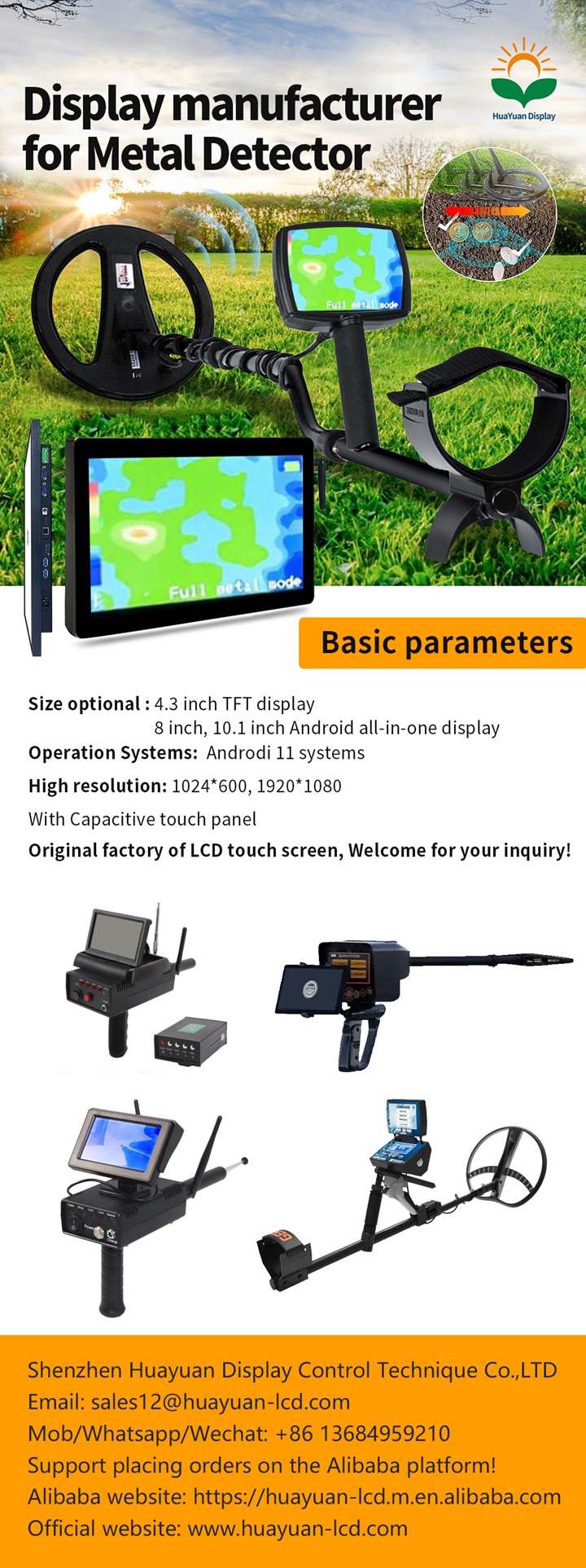
Handheld metal detectors prioritize portability and lightweight design; their accompanying small LCD screens feature low power consumption, compact dimensions, and extended battery life. These devices are primarily utilized in scenarios such as security checks at examination centers, pipeline detection at construction sites, sorting of scrap metals, and shallow-depth metal prospecting outdoors. The screen provides real-time readouts of signal strength, detection depth, and metal identification results, moving beyond the traditional handheld device's reliance solely on audio and visual alerts to make portable detection operations more precise and professional.
IV. Industry Application Development Trends
Driven by advancements in intelligent manufacturing and Internet of Things (IoT) technologies, the application of LCD screens in metal detectors continues to evolve. The display interfaces on these devices are gradually transitioning from traditional small, monochrome screens to high-definition color touchscreens, resulting in more user-friendly human-machine interactions. Furthermore, LCD screens are no longer merely passive display mediums; when integrated with IoT modules, they facilitate cloud-based data uploading, remote device diagnostics, and the automatic generation of inspection reports. In the future, low-power, highly interference-resistant, and integrated LCD technology will drive metal detectors toward the full realization of automated detection, intelligent analysis, and digitized management.
V. Conclusion
LCD screens serve as the core medium for the intelligent upgrading of metal detectors, effectively resolving critical industry pain points associated with traditional detection equipment—such as cumbersome operation, data gaps, low precision, difficult maintenance, and a lack of traceability. By enabling visual interaction, digitized detection, intelligent self-diagnostics, and scenario-specific adaptability, this technology comprehensively enhances both the operational performance and practical value of metal detectors. As safety control and quality inspection standards continue to rise across various industries, the deep integration of LCD technology with metal detection equipment will continue to fortify safety defenses in sectors such as industrial manufacturing, public security, and quality assurance, thereby driving the industry toward digitized, standardized, and high-quality development.