Full Lamination vs Air Gap Lamination: Differences, Advantages & Disadvantages
Full Lamination vs Air Gap Lamination: Differences, Advantages & Disadvantages
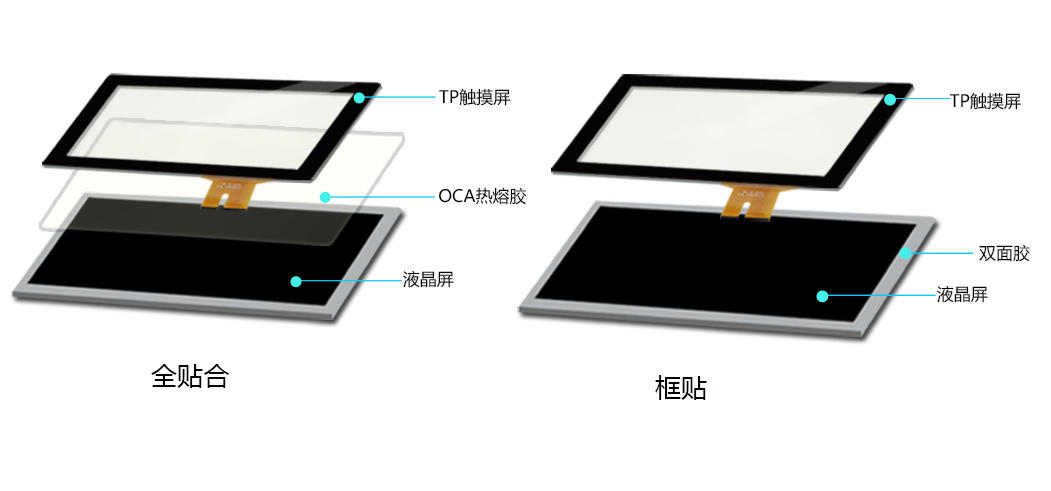
1. Core Structural Difference
1. Air Gap Lamination (Frame Gluing)
Adhesive is only applied along the four borders of the touch panel to fix components. A 0.3~0.5mm air gap remains between the touch layer and LCD screen. The cover glass is suspended above the display like a separate overlay.
2. Full Optical Lamination (OCA/LOCA Lamination)
High-transmittance optical adhesive fully covers the contact surface in a dust-free workshop, completely eliminating the air gap. The cover glass, touch layer and LCD are bonded into an integrated unit. The adhesive has a refractive index close to glass, removing layered light interfaces.
2. Full Optical Lamination: Pros & Cons
Advantages
1. Superior display performance
Eliminates light reflection and refraction between glass and air layers, with light transmittance over 90% and 80% less glare. The screen delivers vivid, transparent colors without a hazy washout effect under strong outdoor sunlight. Images appear flush against the cover glass with no floating visual gap.
2. Accurate, lag-free touch control
No air barrier weakens touch signals, resulting in zero parallax and no touch drift at screen edges. Multi-touch gestures such as swiping and zooming respond smoothly with minimal electromagnetic interference.
3. Dustproof, moisture-proof and anti-fogging
The fully sealed bonded structure prevents dust and moisture from seeping into the middle layer. No internal fogging occurs under drastic temperature fluctuations, making it ideal for vehicle-mounted, outdoor and humid industrial equipment.
4. Slimmer profile and improved shock resistance
The adhesive layer absorbs impact for better drop and vibration resistance, avoiding layer separation upon collision. Removing the air gap reduces overall device thickness by 7~10mm, enabling ultra-narrow bezels and slim chassis designs.
5. Premium uniform black appearance
The screen shows pure black when powered off, with seamless transition between display area and bezels, a standard feature for high-end smartphones, tablets and self-service kiosks.
Disadvantages
1. 30%~50% higher production cost
Requires dust-free workshops, vacuum lamination equipment and costly optical adhesive, accompanied by lower manufacturing yield, raising the total product price significantly.
2. Extremely expensive repairs
A cracked cover glass cannot be replaced separately; the entire screen assembly must be swapped. Separating layers easily damages the LCD panel, with almost no recyclable components after disassembly.
3. Low yield for large-size panels
Panels above 55 inches face high risks of bubbles and deformation during full lamination, leading to drastically inflated costs.
3. Air Gap Frame Lamination: Pros & Cons
Advantages
1. Ultra-low cost with high cost-performance ratio
Simple production process with low equipment entry barriers and over 90% production yield. Pricing is nearly half that of full lamination for the same screen size, suitable for budget-limited projects.
2. Simple, low-cost maintenance
A broken touch cover glass can be replaced independently without disassembling the LCD, cutting after-sales repair expenses.
3. Flexible production and inventory management
No dust-free workshop required; accessible to small and medium manufacturers, with controllable costs for extra-large display screens.
Disadvantages
1. Poor visual experience
Multiple air-glass interfaces cause heavy internal reflection, resulting in washed-out grey visuals indoors and severe glare rendering the screen unreadable under sunlight. Low contrast and transmittance create a persistent foggy overlay; a noticeable white layered border is visible when the screen is off.
2. Degraded touch performance
Obvious parallax causes misclicked edges; the air gap attenuates capacitive touch signals, leading to input lag and intermittent multi-touch failures during sliding operations.
3. Prone to dust accumulation and internal fogging
Only sealed at the four edges, fine dust gradually penetrates gaps over time. Temperature shifts trigger internal condensation fog which cannot be cleaned once formed.
4. Thicker device profile and weak shock resistance
The air gap adds extra thickness, limiting slim and narrow-bezel designs. Vibration or impact easily causes adhesive peeling and warped cover glass edges.
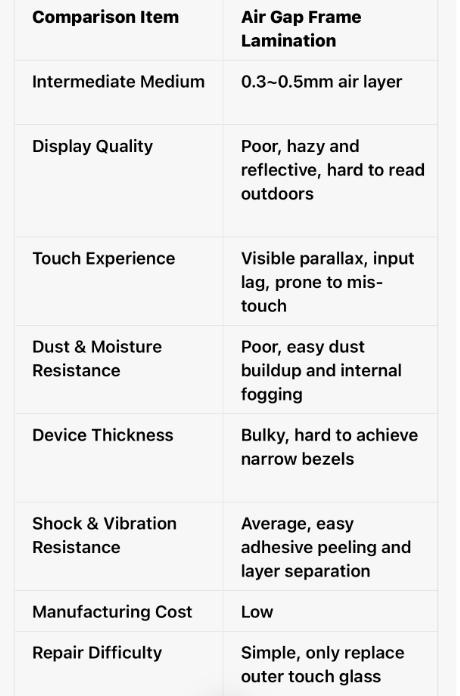
Comparison Table
Comparison Item Air Gap Frame Lamination Full Optical Lamination
Intermediate Medium 0.3~0.5mm air layer OCA/liquid optical adhesive, zero air gap
Display Quality Poor, hazy and reflective, hard to read outdoors Excellent, high transparency & contrast, visible under strong light
Touch Experience Visible parallax, input lag, prone to mis-touch Precise instant response, no offset, stable multi-touch
Dust & Moisture Resistance Poor, easy dust buildup and internal fogging Outstanding, fully sealed to block moisture and dust
Device Thickness Bulky, hard to achieve narrow bezels Slim, supports ultra-thin and narrow-border designs
Shock & Vibration Resistance Average, easy adhesive peeling and layer separation Strong, adhesive layer cushions screen impact
Manufacturing Cost Low 30%~50% higher
Repair Difficulty Simple, only replace outer touch glass Very difficult, full screen assembly replacement mandatory
Typical Application Scenarios Low-budget indoor industrial monitors, basic query terminals, low-cost display screens Smartphones, tablets, vehicle displays, outdoor self-service equipment, high-end industrial all-in-one PCs, medical devices
Selection Guidelines
1. Choose Full Optical Lamination if:
Equipment is used outdoors or in vehicles, medical devices, high-end self-service kiosks, slim tablets/phones; frequent multi-touch operation required; dusty/humid working environments; high standards for visual quality and appearance.
2. Choose Air Gap Frame Lamination if:
Indoor-only low-budget equipment, infrequent simple tapping operations, large-size low-cost advertising screens, high after-sales repair volume, priority on cost control.