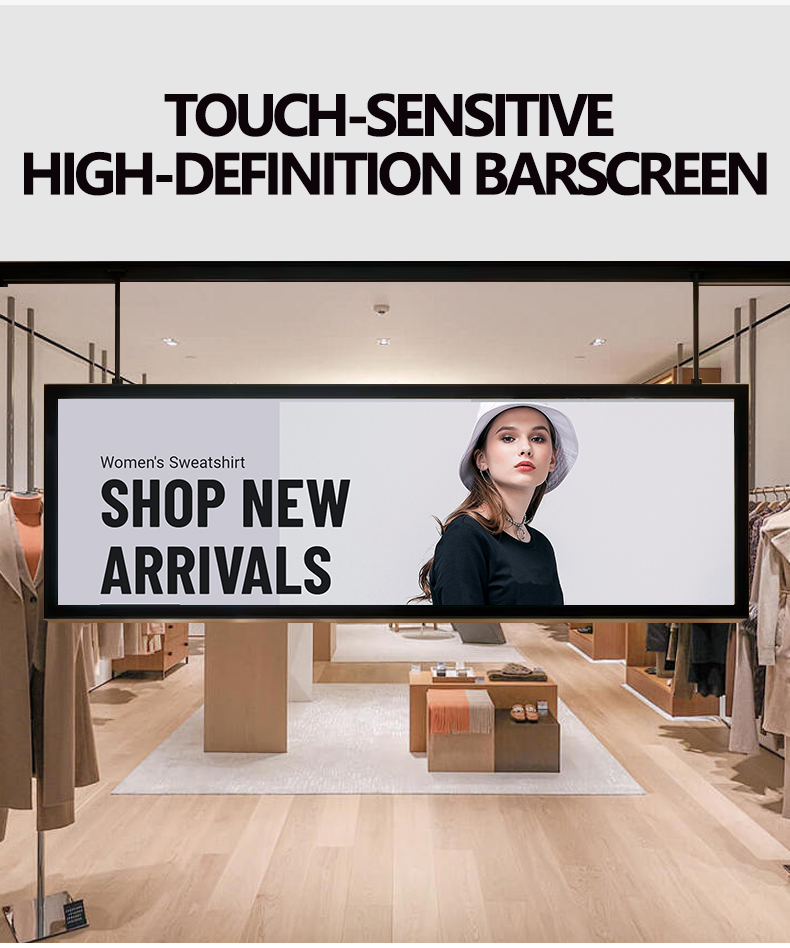
Bar screen: the "information artery" under ultra wide field of view - reshaping the connection between space and information
1、 Core Features and Technical Advantages of Bar Screen

The art of spatial adaptation: The most prominent advantage of strip screens is their perfect adaptability to narrow spaces. It can seamlessly integrate into spaces that traditional square or wide screens cannot effectively utilize, such as window sills, shelf edges, elevator cars, narrow columns, building beams, etc., transforming "idle space" into an "information battlefield".
Linear guidance of information flow: Ultra wide ratio is naturally suitable for displaying horizontal information sequences. Whether it's scrolling text news from left to right, continuous timeline data, or multiple information points compared side by side, bar screens can provide a smoother and less interrupted visual flow, in line with human reading habits.
Visual appeal and technological sense: Unconventional screen shapes themselves have strong visual appeal and modern technological sense, which can effectively capture attention and enhance brand image in commercial environments.
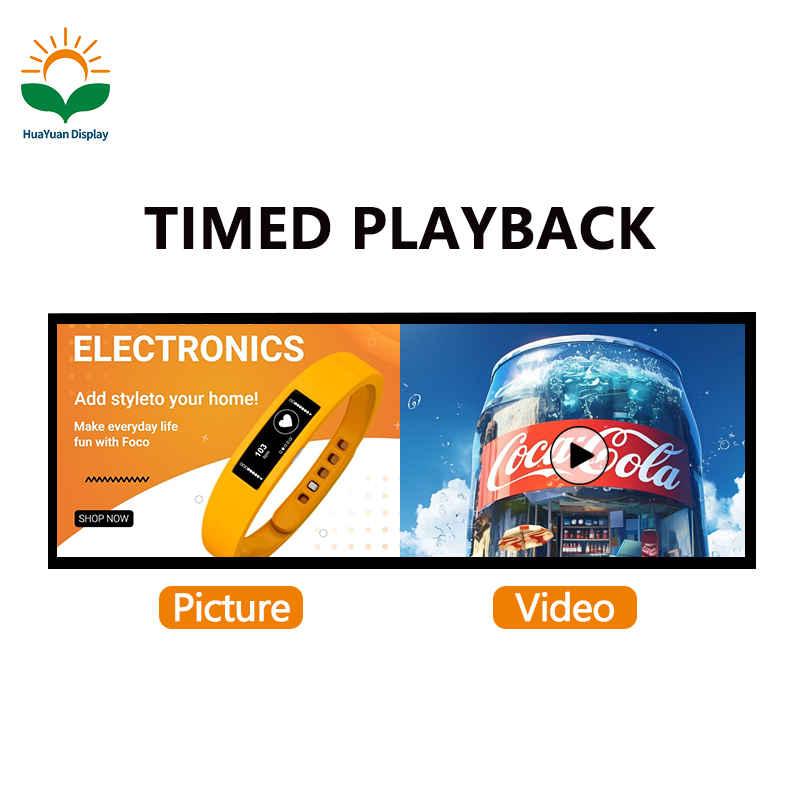
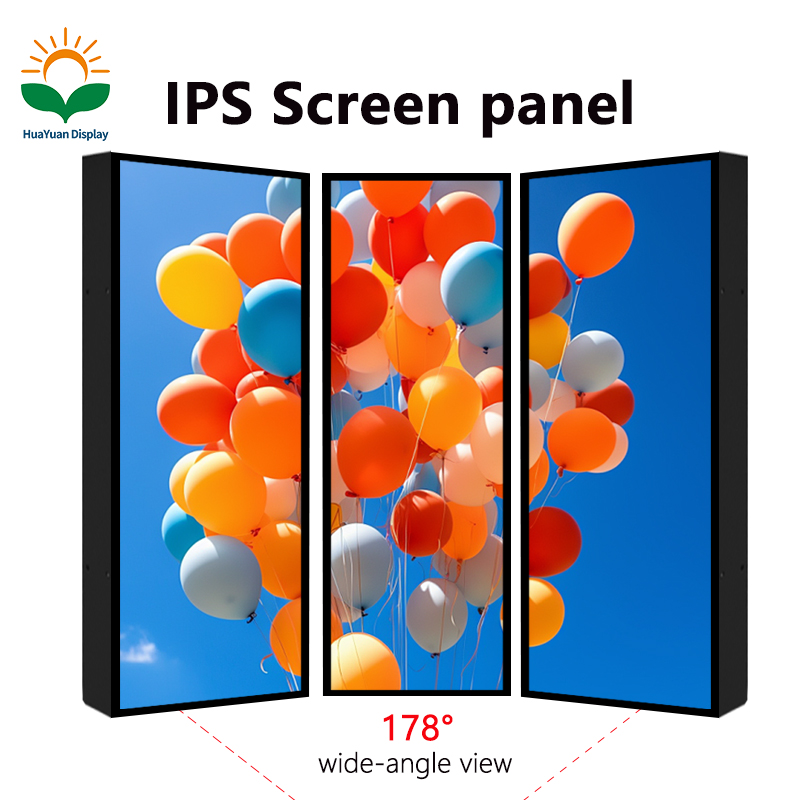
High integration and customization: Modern strip screens usually use LED module splicing or customized LCD panels, which can achieve ultra long dimensions (tens of meters), irregular bending (arc, ring), high resolution and high brightness (meeting strong light environments), and can be deeply integrated with sensors, touch modules, and communication modules.
2、 In depth analysis of core application areas
1. New Retail and Commercial Display
Retail space is the most widely used and innovative field for strip screens, with the core goal of bridging the last centimeter between digital information and physical shelves.
·Intelligent shelves and electronic price tag system: replacing traditional paper price tags with strip screens, it can not only dynamically display prices, promotional information, and origin traceability, but also achieve real-time price changes based on backend data (such as dynamic pricing of fresh products), inventory visualization ("only X pieces left" display), and personalized recommendations (display different information based on user profiles).
·Window display and display cabinet interactive strip: a strip screen installed on the inside of the window glass or at the edge of the booth, forming an uninterrupted digital advertising strip that plays brand stories, product videos, promotional activities, and can attract passersby to stop by through facial recognition and sensory interaction.
·Indoor signage and information corridor: A strip screen deployed above the atrium and corridor of the shopping mall serves as a dynamic signage system to guide the direction of the store, while also releasing mall activities, weather, news, etc., creating a strong commercial atmosphere.
·Case: Alibaba's "cloud shelves" and JD. com's "smart shopping cabinets" both extensively use bar screens to seamlessly connect offline shelves with online shopping malls, achieving "see and buy".
2. Public transportation and smart travel
In traffic scenarios that pursue efficient information transmission and safety management, bar screens play a dual role as "information guides" and "safety guards".
·Subway/high-speed rail dynamic information display: A long strip screen above the gangway or door inside the carriage displays real-time arrival information, train operation status, time, emergency notifications, and news messages. Service information and advertising content can be played in different areas.
·Bus/Taxi Information Screen: A bar screen at the front, rear, or side of the bus that clearly displays the route number, destination, real-time traffic conditions, or service status, enhancing the recognition and operational efficiency of public transportation.
·Airport check-in/baggage retrieval guidance: The bar screen above the check-in island or around the baggage carousel provides clear and continuous information flow such as flight status and baggage carousel number, guiding passengers to pass efficiently.
·Highway information board: The ultra wide and high brightness LED strip screen serves as a variable information board (VMS), providing real-time updates on road conditions, weather warnings, construction information, and traffic safety alerts. It is an important component of smart highways.
3. Enterprise exhibition hall, conference and command control center
In these professional settings that require high levels of information integration and visualization, bar screens are a key component in building the 'digital nerve center'.
·Corporate image wall and data dashboard: The giant curved or straight strip screen wall at the entrance plays corporate promotional videos in a loop or presents key business data in real-time (such as global sales maps and production data streams), which is highly visually impactful.
·Command and dispatch center: In command centers such as public security, emergency, power, and transportation, strip screens are often placed above or below the main screen curtain wall as a fixed "information function area", continuously displaying key parameters such as time, date, duty table, global warning, communication status, etc., complementing the dynamic screen of the main screen.
·Video conference room reservation display: A bar screen outside the conference room door dynamically displays the conference room name, current reservation status (in progress/available), next meeting time and theme, achieving transparent management of conference room resources.
4. Smart cities and public services
Bar screens are becoming an important carrier for the intelligence of urban furniture and visualization of public services.
·Smart Light Pole Integrated Screen: A smart light pole integrated with 5G micro base stations, environmental monitoring, charging stations, and other functions. Its strip screen can display municipal announcements, air quality data, public Wi Fi passwords, surrounding navigation, and other information.
·Bank/Government Hall Waiting Call Screen: The bar screen above the window clearly displays the current processing number, service window, and number of people waiting, relieving queue anxiety and improving service experience.
·Library/Museum Information Guide: A bar screen deployed in the bookshelf area or exhibition line, providing immersive information services such as book search guidance, extended introduction of exhibit backgrounds, and tour route prompts.
5. High end home furnishings and personalized customization
Bar screens are integrating into private living spaces in a more artistic way.
·Kitchen Intelligent Control Belt: Integrated on the lower edge of cabinets or above the stove, it displays recipe steps, timers, and intelligent home appliance control interfaces, becoming the center of modern intelligent kitchens.
·Home audio and video room decoration information screen: a strip screen installed under the sound equipment cabinet or TV wall, which can display information about the songs being played, family schedule, smart home status, or pure artistic images.
·Customized art decoration: The ultra high definition micro pitch LED strip screen can be used as a digital frame or wall decoration, playing dynamic art works and achieving personalized and digital home decoration.
3、 Market drivers and technological challenges
Core driving factors:
·The digital wave: The comprehensive digital transformation of industries such as retail, transportation, and government has given rise to a massive demand for new information display terminals.
·Maximizing spatial value: Commercial and public spaces have high rents, and creating value with every inch of space has become a necessity. Bar screens are a powerful tool for increasing spatial information density.
·The demand for precise information push: The Internet of Things and big data technology make it possible to push accurate information based on location, time, and crowd, and the bar screen is an ideal receiving and presenting terminal.
·Hardware cost reduction and performance improvement: The cost of LED display modules continues to decrease, resolution (Pitch value) continues to increase, brightness, power consumption, and reliability continue to be optimized, promoting the popularization of strip screens.
Technological and business challenges faced:
·Content adaptation and production: The production of ultra wide proportion content requires specialized design standards and tools, and the content ecosystem is not yet perfect.
·Heat dissipation and stability: The design of heat dissipation in narrow spaces presents great challenges, especially for high brightness outdoor applications, which require extremely high product reliability and lifespan.
·System integration complexity: involves multiple aspects such as hardware installation, signal transmission, content management, and data docking, requiring a professional overall solution provider.
·Initial investment cost: Compared to traditional signage, the initial investment for high-end strip screen systems (especially small pitch LEDs) is still relatively high.
4、 Future Development Trends
1. Tighter interaction integration: Integrating non-contact sensors such as millimeter wave radar and TOF cameras to achieve more accurate human-computer interaction (such as gesture control, crowd counting, and stop analysis).
2. Diversification of display technology: New display technologies such as flexible OLED and transparent Micro LED will endow strip screens with richer forms (bendable, rollable) and application scenarios (such as transparent window displays).
3. AI driven content automation: Combining AI content generation and intelligent orchestration systems, bar screen content can be automatically generated, adjusted, and played based on real-time data (such as weather, passenger flow, inventory) and preset strategies.
4. "Screen as a Service" business model: shifting from selling hardware to providing integrated services of "hardware+content+data+operation", a monthly subscription model may emerge.
5. Standardization and modularization: Standardization of interfaces, dimensions, control protocols, and plug and play modular design will lower deployment and maintenance barriers and accelerate popularization.
5、 Conclusion: Reshaping the 'information line' of space
The analysis of the application fields of bar screens reveals a profound logic: in the era of Internet of Things, display technology is evolving from a "centralized" viewing point to a "distributed", "embedded", and "environmental" direction. Bar screens are the epitome of this trend. It is no longer a "black box" disconnected from the environment, but an "information line" or "data flow" highly integrated into the architectural texture, transportation carriers, and commercial processes.
It, with its unique form, has opened up horizontal information transmission channels in modern cities and commercial environments with limited vertical space, achieving a balance between information density and spatial aesthetics. In the future, with the further maturity of technology and the improvement of ecology, bar screens will not only be displays of information, but also intelligent interactive interfaces that perceive the environment, connect services, and trigger actions. They will continue to weave invisible "digital neural networks" in many fields such as retail, transportation, cities, and offices, silently promoting the improvement of social efficiency and the transformation of user experience.
From the "rational symmetry beauty" of square screens to the "linear flow intelligence" of bar screens, the development history of special proportion displays tells us that the best technological design is always the perfect resonance of form, function, and scene.